
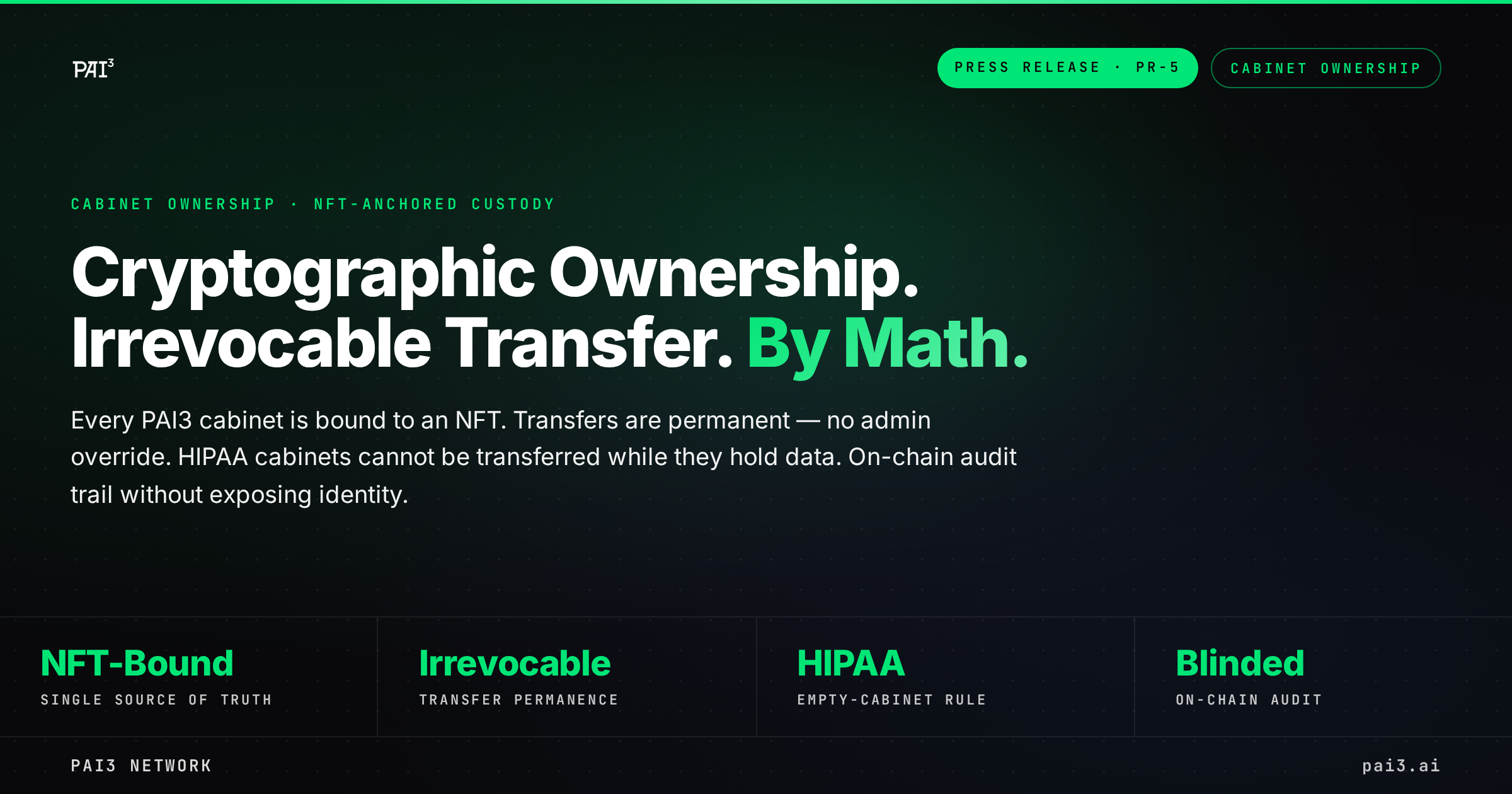
Cheyenne, WY, - May 14, 2026 - PAI3 Network today announced its finalized cabinet ownership architecture, a system that uses NFT-anchored ownership to establish cryptographic, verifiable, and irrevocable data sovereignty for professionals operating regulated workloads on PAI3 infrastructure.
In the PAI3 architecture, every data cabinet is bound to an NFT — not to a username, not to an email address, and not to a wallet address that can be re-keyed. The NFT represents node identity, and the binding between cabinet and NFT is the single source of truth for ownership. The model eliminates ambiguity about data custody and provides on-chain proof of ownership history.
"Ownership should not require a lawyer to prove," said Pradeep Goel, CEO of PAI3 Network. "In the PAI3 system, ownership is a cryptographic fact. Your cabinet is bound to your NFT. The blockchain records it. No dispute, no ambiguity, no intermediary."
Key architectural decisions
Irrevocable assignment. Cabinet transfers are permanent. Once assigned to a new NFT, the previous owner has zero access. All permissions are wiped. The model mirrors how physical property works — when you sell a building, you do not keep a key.
HIPAA-aware transfer rules. Cabinets classified as HIPAA cannot be transferred if they contain any data. They must be empty — zero contents, zero oracle-ingested records, zero embeddings. No override, no admin bypass. For non-HIPAA secure cabinets with data, a double-confirmation flow with explicit content disclosure and name-typing prevents accidental transfers.
Credential separation. When a cabinet transfers, oracle configurations — field mappings, sync schedules, data transformations — travel with it. Credentials never do. The new owner supplies their own API keys and the pre-configured oracles activate.
Privacy-preserving audit trail. On-chain audit records use blinded event hashes (SHA-256 with per-event salts). The blockchain proves that ownership events occurred without revealing who owns what. Only the cabinet owner can verify their own events.
Who this is built for
Cabinet ownership is built first for professionals operating under regulatory custody obligations — attorneys with client privilege, accountants with financial-records duty, and healthcare providers operating under HIPAA. For each of these audiences, the question "who has access to this data, and can it be proven?" is no longer a vendor promise; it is a property of the system.
For attorneys, irrevocable transfer eliminates the "backup copy" problem when matter ownership changes hands. For accountants, the blinded on-chain audit trail proves chain of custody without exposing client identities. For healthcare providers, the HIPAA transfer rule structurally prevents PHI-bearing cabinets from being moved without proper handling.
How it fits with self-sovereign keys
Cabinet ownership relies on the self-sovereign key management architecture announced in PR-4. Cabinet contents are encrypted with keys derived from the node's master key — and PAI3 does not hold sufficient key material to reconstruct that master key. Combined, the two layers mean a cabinet is owned cryptographically (via NFT binding) and locked cryptographically (via keys only the operator can reconstruct). Ownership and access are anchored by the same mathematics.
Technical summary
-
NFT-bound cabinet ownership — single source of truth, no username/wallet aliasing
-
Irrevocable transfer — previous owner loses all access on assignment to a new NFT
-
HIPAA cabinet transfer block — empty-cabinet requirement, no admin override
-
Credential separation — configurations transfer, secrets do not
-
Blinded SHA-256 audit trail — on-chain proof without revealing identity
-
Operator-side verification — only the cabinet owner can decode their own events
Availability
Cabinet ownership is part of the PAI3 V3.4 platform release and ships on all PAI3 Power Nodes. Operators can review ownership records and pending transfers inside the node dashboard.
ABOUT PAI3 NETWORK
PAI3 Network is a decentralized personal AI infrastructure platform built around the Power Node — hardware that operators own and operate to run AI workloads on their own data. The PAI3 platform is HIPAA-ready and GDPR-ready by design. Tokens issued in connection with the network are utility tokens used for compute access, governance participation, and ecosystem coordination; they are not financial instruments and no return on investment is implied or promised.
Learn more at pai3.ai.

 Login
Login